Why Your Foundation Looks Different in Daylight, Store Light, and Flash
The same foundation can look perfect at home and wrong in the store, or the reverse. Learn why daylight, indoor bulbs, store lighting, and phone flash change how a shade reads, plus a 5-minute test you can do before you buy.
The short answer
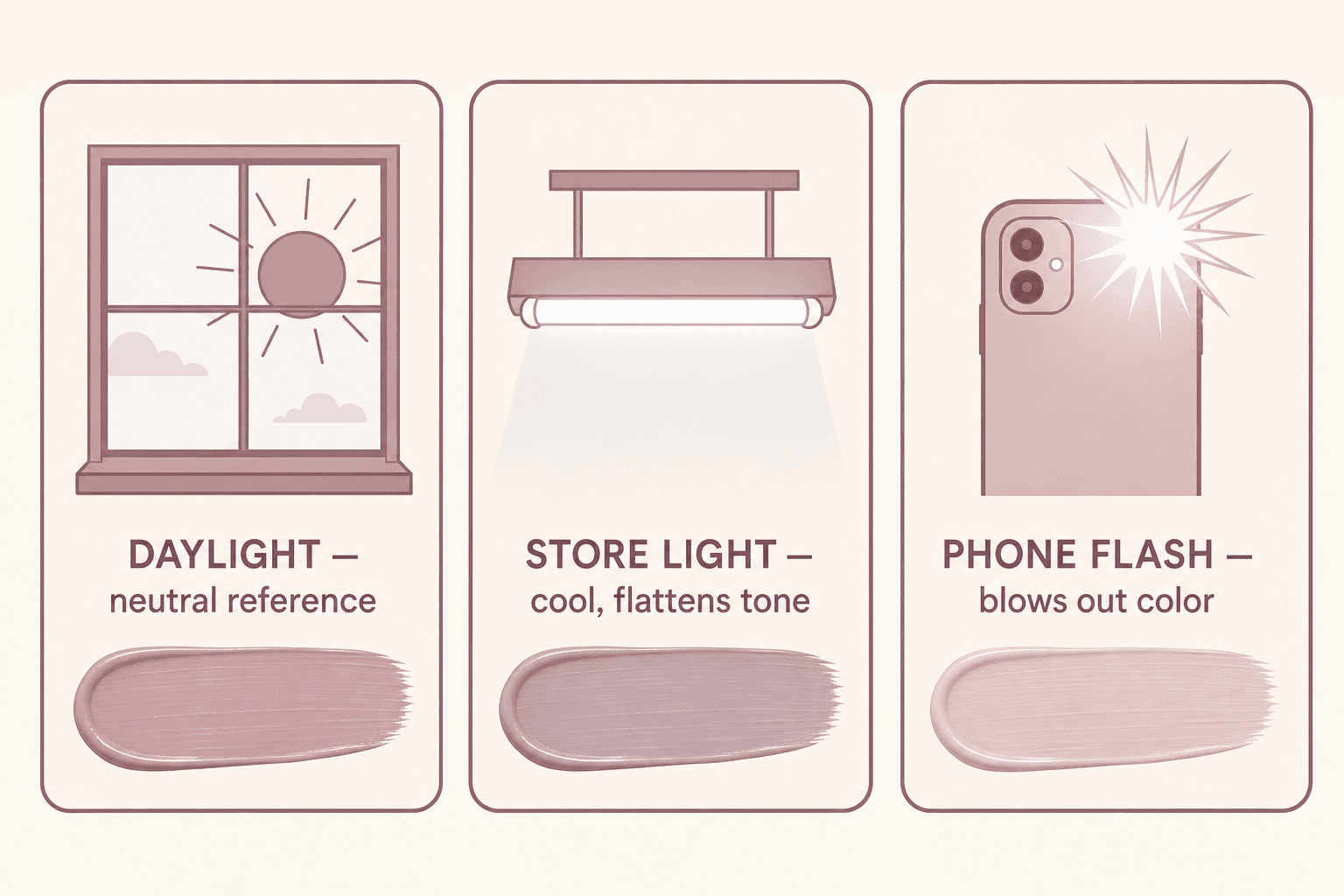
If a foundation looks right in one light and off in another, the shade is not automatically wrong—the light is changing what you see. Midday daylight from an open window (not direct sun) is the closest thing to a neutral reference. Warm indoor bulbs push everything yellow-orange, cool store lighting pushes things blue-gray or green, and phone flash blows out color entirely, so it is the least reliable of the four.
Before you return or rebuy a foundation, check it on your jawline in daylight. If it disappears there and blends into your neck, the shade is probably right and the room was misleading you.
Why the same shade reads differently everywhere
Every light source has a color temperature, and that temperature tags a warm, cool, or neutral cast onto everything it touches. Soft white bulbs at home (around 2700–3000K) add a yellow-orange cast that can make a slightly cool foundation look better blended than it really is, while a warm foundation can look almost orange.
Store lighting is often fluorescent or harsh LED (roughly 4000–5000K, sometimes with a greenish tint), which flattens natural shadow and exaggerates any gray or orange cast in a formula. This is the single most common reason people think a shade is “too ashy” at the counter, then it looks completely fine an hour later at home.
Phone flash is a direct, cool-toned burst of light aimed straight at your face. It blows out highlights, crushes subtle color differences, and gets further distorted by your camera’s automatic white balance, which is quietly shifting colors to “correct” the photo. A selfie taken with flash is closer to a guess than a test.
Underneath all of this is a real optical effect called metamerism: a foundation and your skin are made of different materials (pigments and dyes versus skin’s own melanin, hemoglobin, and light scattering), so they can reflect light similarly under one source and differently under another. Two things can look identical in the store and diverge by daylight—that is not a bad match, it is metamerism doing exactly what it does.
A 5-minute daylight test you can do today
You do not need special equipment for this—just a window and a few minutes.
1. Find a window at midday with indirect light (stand a step back from direct sun, which is harsh and washes out color, not neutral). 2. Swatch two or three candidate shades in a thin stripe along your jawline, extending slightly onto your neck—not on your hand, which is often a different depth and undertone than your face. 3. Wait two to three minutes; some formulas oxidize and shift warmer or deeper as they set. 4. Step back and check three things: does the stripe disappear at both edges, does it match your neck and chest (not just your face), and does it look gray or orange in this specific light. 5. For a real-world gut check, glance at the same stripe near a warm lamp—expect it to look slightly warmer there, which is normal, not a failed match.
Common failure cases: swatching only on your hand (the #1 reason online shade matches disappoint), testing more than three shades at once (your eye stops discriminating), judging a shade from a flash photo instead of in person, and testing in direct midday sun, which can make almost anything look like it “disappears” even when it is wrong. If daylight and warm lamp light disagree slightly, trust daylight and note it—“true in daylight, warm at night” is a normal, wearable shade, not a mismatch.
Where Glowmi fits in
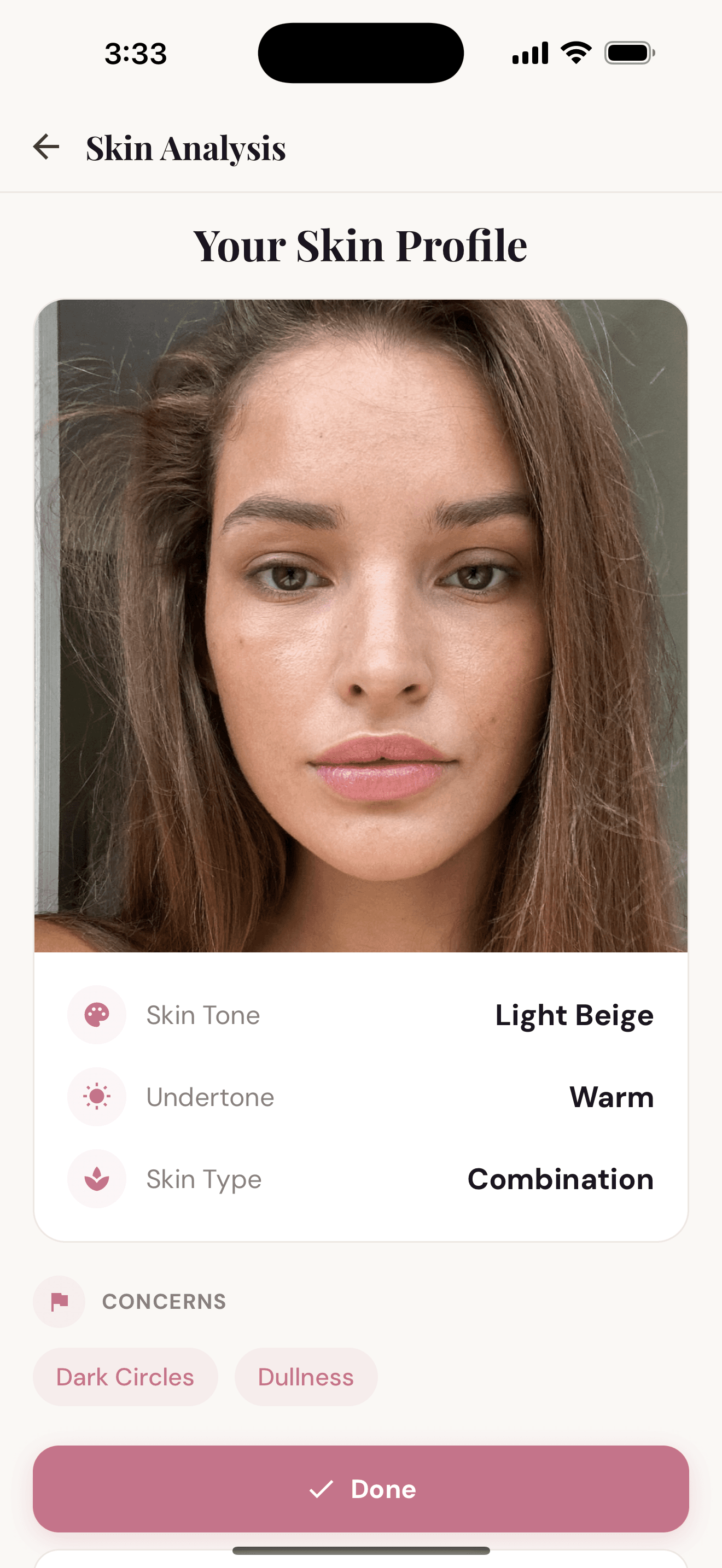
Glowmi’s Skin Analysis reads your visible tone and undertone from a bare-face selfie taken in even light, then turns that into a starting shade and palette brief—cool, warm, or neutral family, and an approximate depth—so you are not starting the daylight test from zero every time you shop.
It does not replace the window test above, and it is not a medical diagnosis or a guarantee of one exact bottle across every brand; treat it as a faster starting point, then confirm any real pick on your jawline in daylight. After onboarding, the full analysis and palette experience is part of Glowmi Pro, with fair daily and monthly usage limits and no free trial. Glowmi is iOS only.
Keep reading
How to Find Your Foundation Shade Without Guessing
Match foundation by depth and undertone first, avoid common mismatches, and use Glowmi’s skin analysis as a smarter starting point.
What Is Skin Undertone? A Practical Guide for Makeup
Skin undertone is the cool, warm, or neutral hue under your surface tone. Learn how it differs from skin tone and how to use it when choosing foundation, blush, and lips.
How AI Skin Analysis Works for Makeup Guidance
AI skin analysis for makeup reads visible traits from a selfie—tone, undertone, type cues, and surface concerns—to suggest shades. It is not a medical diagnosis.