Beauty Journal Tips: Track Products and Looks That Work
Keep useful product and makeup-look notes with a simple journal template, a one-minute entry, and a repeatable way to review what works for you.
On this page
The short answer
A useful beauty journal connects a look with the products, amounts, and decisions that made it work for you. Start with one photo and a short note. A notebook, notes app, or dedicated library can all do the job; consistency is more useful than elaborate formatting.
The goal is to answer a future question: what did I use, what did I like, and what should I change next time? A saved image without that context is often harder to recreate.
Log a product once, then link it to looks
Record the brand, full formula name, shade name or code, category, and your own observation. Formula matters because a familiar shade name in a different product may not behave the same way. A quick photo of the label can prevent confusion when packaging changes.
For shade decisions, separate depth and color direction in the note. “Too peachy at this depth” is more useful than “not my shade.” The foundation guide shows how to produce a note you can take to your next comparison.
- Identity: brand, formula, shade, and a label photo if useful.
- Use: where you apply it, usual amount, tool, and whether you pair it with another product.
- Observation: what worked for your aim, what did not, and the conditions of the comparison.
- Timing: when you opened it and any package instructions or expiration information you want to remember.
A one-minute finished-look entry
You do not need to record every detail of a routine you already know. Capture the choices that distinguish this look from your usual one.
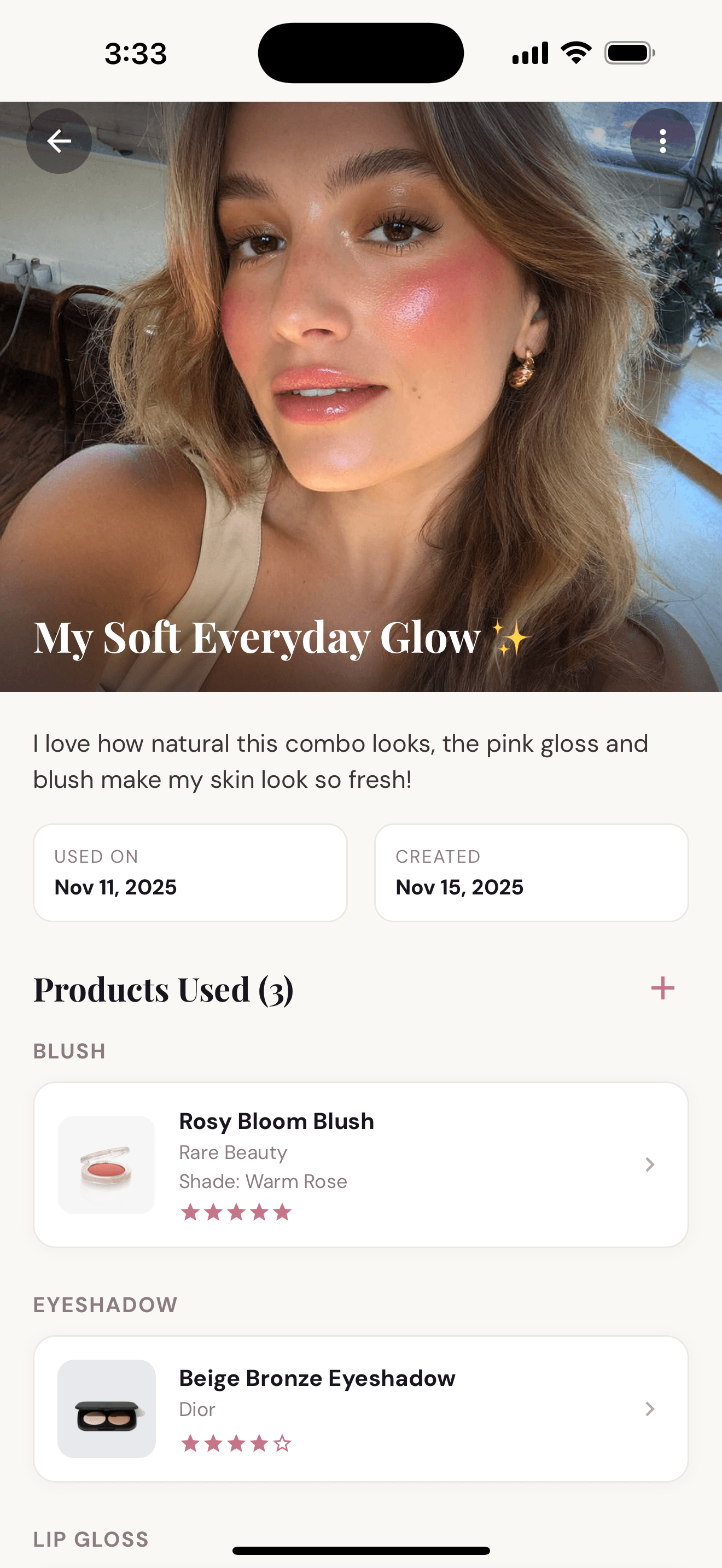
- Save one clear image of the real application, with the date and occasion. Keep a generated preview separate from the finished result.
- Name the aim: soft daytime, lip-led, defined eye, or another description that means something to you.
- Link the exact products used. Add the distinctive placement or layering step that a product list alone would miss.
- Write one thing to keep and one thing to try next time. Avoid changing every element after a single photograph.
- Return to the note when you recreate the look and add whether the change helped.
A worked example of a reusable note
An illustrative entry might read: “Workday, soft eye and rose lip. Brown pencil close to upper lashes; blush applied lightly before lip. Keep the lip color. Next time use less depth at the outer corner.” The exact product records would sit alongside it, so there is no need to remember which brown pencil you meant.
If the photo looked warmer than the mirror, record that uncertainty instead of changing the shade record. Compare under similar conditions before deciding that a product has become unsuitable. The lighting guide explains why photo conditions deserve their own note.
Review patterns without turning notes into rules
After a few comparable entries, look for decisions you keep repeating: a lip opacity you enjoy, a cheek placement that suits your aim, or a base preparation that gives the finish you prefer. Use these as options for your next routine rather than permanent limits on your style.
A personal palette can grow from those combinations. If a finished look needs refinement, the feedback method helps turn a vague dislike into one specific experiment.
Use records sensibly for product care
An opening date is a reminder, not proof that a product is safe indefinitely. Follow the package directions and manufacturer guidance. FDA consumer advice discusses storage, sharing, and expiration information; a journal cannot assess contamination or replace those directions.
Keep a short repeat-or-skip note for your own preferences, and avoid presenting a personal observation as a result that applies to every person. You are building a record of your choices, not a clinical assessment or a universal product ranking.
Where Glowmi’s Vanity fits in
Glowmi’s Vanity stores products with brand, category, shade, photos, rating, and notes. Save looks and link their products so you can find the details together. It can support the system above; the same note-taking method also works without the app.
During onboarding you can see your season, a first shade, and your first look. Glowmi Pro unlocks the full experience afterward, with no free trial and fair daily and monthly AI usage limits. Glowmi is available on iOS; see the App Store for current plans.
Sources and further reading
Brand references describe their own methods and products. Our worked examples are illustrative, not records of product tests.
- FDA: using cosmetics safely
Consumer guidance on product directions, sharing cosmetics, storage, and expiration information.
- How Glowmi’s face scan works
Our app’s features and limits; this is product information, not independent validation.
Keep reading
Makeup Look Feedback: How to Improve a Finished Look
Review a finished makeup look with a clear brief, consistent photo, and one useful adjustment. Includes a checklist and example feedback notes.
What Makeup Colors Suit Me? Build Your Personal Palette
Find eye, lip, and cheek colors you enjoy wearing together. See a Glowmi color-season example, compare real products, and build a personal makeup palette.
Virtual Makeup Try-On: Preview Makeup on Your Own Face
Preview makeup on your own face before applying it. See Glowmi’s before-and-after example, compare looks, and turn a preview into a real makeup plan.