What Makeup Colors Suit Me? Build Your Personal Palette
Find eye, lip, and cheek colors you enjoy wearing together. See a Glowmi color-season example, compare real products, and build a personal makeup palette.
On this page
The short answer
To find makeup colors that suit you, compare eye, cheek, and lip shades on yourself in consistent light. Use depth, undertone, and the amount of contrast you enjoy as starting points, then keep a small group that you like wearing together. A personal makeup palette is a practical shortlist, not a rule about every color you may wear.
You can begin with products you already own. The first goal is one reliable look, not a complete new collection or a definitive seasonal label. For a starting combination, take the free makeup quiz, then edit an eye, cheek, and lip palette around your preferences.
Can an app suggest makeup colors from a selfie?
Yes. Glowmi for iPhone uses a bare-face selfie to suggest a 12-season color type and eye, lip, and cheek shades, with an explanation for each shade. Treat the result as a starting point for comparing real products. Lighting and camera color can affect a photo, and a suggested shade name is not an exact match to a product sold by another brand.
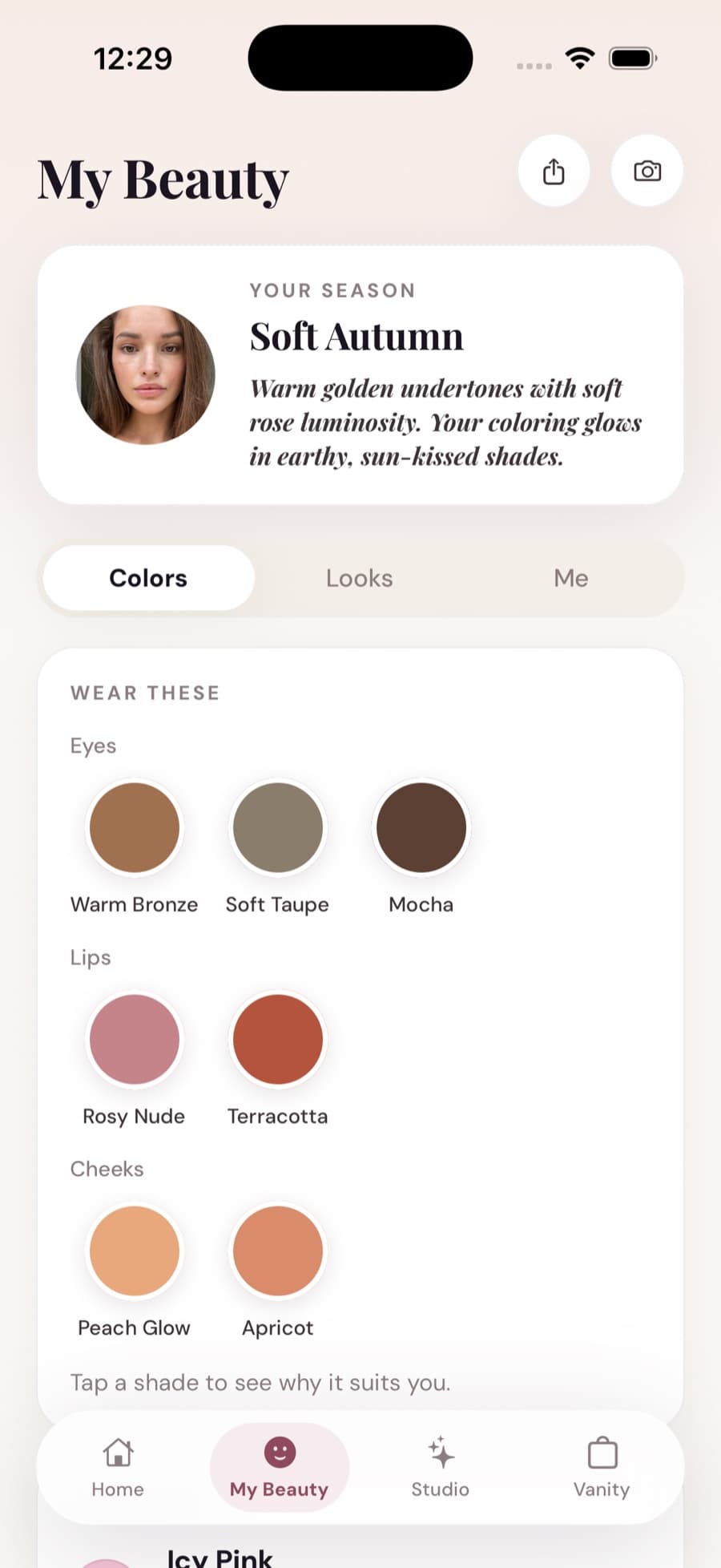
The screenshot below is one Soft Autumn example from Glowmi. It groups eye, lip, and cheek suggestions in the same Beauty Profile so you can plan a complete combination. It illustrates the app’s output for this profile; it is not a color prescription for everyone with the same season.
Choose a reference look and a useful constraint
Pick the situation you dress for most often: everyday work, a quick routine, or a soft evening look. Decide how much time and how many products you want to use. A palette that requires steps you never enjoy will not be a reliable everyday system.
Use undertone and depth as descriptive clues, then compare the actual products. A label on a palette box cannot settle whether you like its contrast, opacity, or finish on your face.
Read the Soft Autumn example as a set of options
The example above suggests Warm Bronze, Soft Taupe, and Mocha for the eyes; Rosy Nude or Terracotta for the lips; and Peach Glow or Apricot for the cheeks. Choose one direction for each area rather than applying every suggestion together.
- For a quieter version, compare a soft taupe eye direction, a light peach cheek, and a sheer rosy lip using products you already own.
- For more definition, compare a deeper eye accent or a more opaque lip while keeping the other areas similar. Check whether you enjoy the change in contrast.
- To plan placement as well as color, preview makeup on your own face, then confirm the real application in the mirror. A screen preview cannot settle formula, finish, or wear.
Build your first combination
Work from a product you already like rather than changing the entire face at once. These steps can be done in a notebook or a notes app.
- Choose an anchor: an eye, lip, or cheek product that you enjoy wearing. Note its color direction and how sheer or strong you usually apply it.
- Add a supporting cheek or lip. Keep one element quieter while deciding whether the pair gives the balance you want.
- Add a simple eye direction: a soft wash, definition near the lashes, or a deeper accent. Choose the smallest version that completes your intended look.
- Wear the combination in ordinary light. Decide what you want to keep before replacing a product that merely looked different in one photo.
- Record the exact products, placement, and amount. Try the same combination again so you know it is repeatable, then add an alternative.
Two example briefs you can adapt
These are illustrative combinations, not tested shade prescriptions or guarantees for a complexion. Swap any element that does not suit your preferences. The same color name can describe very different products.
- Soft, low-contrast brief: a sheer rose-toned lip, a restrained cheek in a compatible direction, and a soft taupe or brown eye accent. Start with light application and adjust contrast to taste.
- Warmer, more defined brief: a peach or terracotta cheek direction, a warm brown eye accent, and a lip that leaves either the cheeks or lips as the stronger focus. Compare real swatches rather than buying from these names alone.
- A more expressive variation: keep your familiar eye and cheek, then change only lip opacity or color. You can enjoy a deliberately contrasting shade without treating it as a palette mistake.
Troubleshoot the combination before replacing the kit
If a cheek color looks separate from the rest of the face, first compare a lighter application and a different placement. If that does not support your aim, compare another color direction using the cool and warm blush method. Amount, finish, and contrast can matter as well as temperature.
If everything looks harmonious except the base, solve that separately with the foundation shade comparison. Buying new lip and cheek products to compensate for an unwanted base color can make the experiment harder to interpret.
Keep an everyday version and one variation
Once you like a combination, repeat it and write down what changes when you want more definition. You might deepen the lash-line accent while leaving the cheek alone, or keep the eye soft and use a more opaque lip. A useful palette grows from tested combinations rather than a long list of theoretical matches.
Keep the details in a beauty journal: product names, amount, placement, setting, and what you want to repeat. The notes make it easier to shop selectively when something runs out.
Where Glowmi’s color suggestions fit in
Use your Beauty Profile as an initial shortlist, explore the explanation for a shade, then compare actual products. Save the combinations you enjoy in Vanity with the products used so the palette becomes something you can recreate.
During onboarding you can see your season, a first shade, and your first look. Glowmi Pro unlocks the full experience afterward, with no free trial and fair daily and monthly AI usage limits. Glowmi is available on iOS; see the App Store for current plans.
Sources and further reading
Brand references describe their own methods and products. Our worked examples are illustrative, not records of product tests.
- M·A·C: foundation shade names and undertones
Explains M·A·C’s naming convention and why shade labels need a brand-specific interpretation.
- How Glowmi’s face scan works
Our app’s features and limits; this is product information, not independent validation.
Keep reading
Cool vs. Warm Blush: How to Match Blush to Your Undertone
Compare cool and warm blush on yourself, control amount and finish, and find a cheek-and-lip combination you enjoy without rigid undertone rules.
What Is Skin Undertone? A Practical Guide for Makeup
Understand undertone versus skin depth, compare real swatches, and turn mixed results into useful shade notes without relying on one shortcut.
Beauty Journal Tips: Track Products and Looks That Work
Keep useful product and makeup-look notes with a simple journal template, a one-minute entry, and a repeatable way to review what works for you.