How to Find Your Makeup Color Season
Compare temperature, depth, and softness to narrow a makeup palette. Learn what the seasons mean, how to test them, and what to do when two seem close.
On this page
Compare warmth, depth, and softness
To find a starting makeup color season, compare warmer with cooler colors, lighter with deeper colors, and muted with clearer colors in consistent daylight. Keep the preferences that repeat. A brief such as ‘cooler, soft, medium-depth makeup’ is useful even when the exact season is uncertain.
- Temperature: peachy rose versus mauve rose at a similar depth.
- Depth: a lighter and deeper version of a similar color.
- Softness: a muted and clearer version without a large depth change.
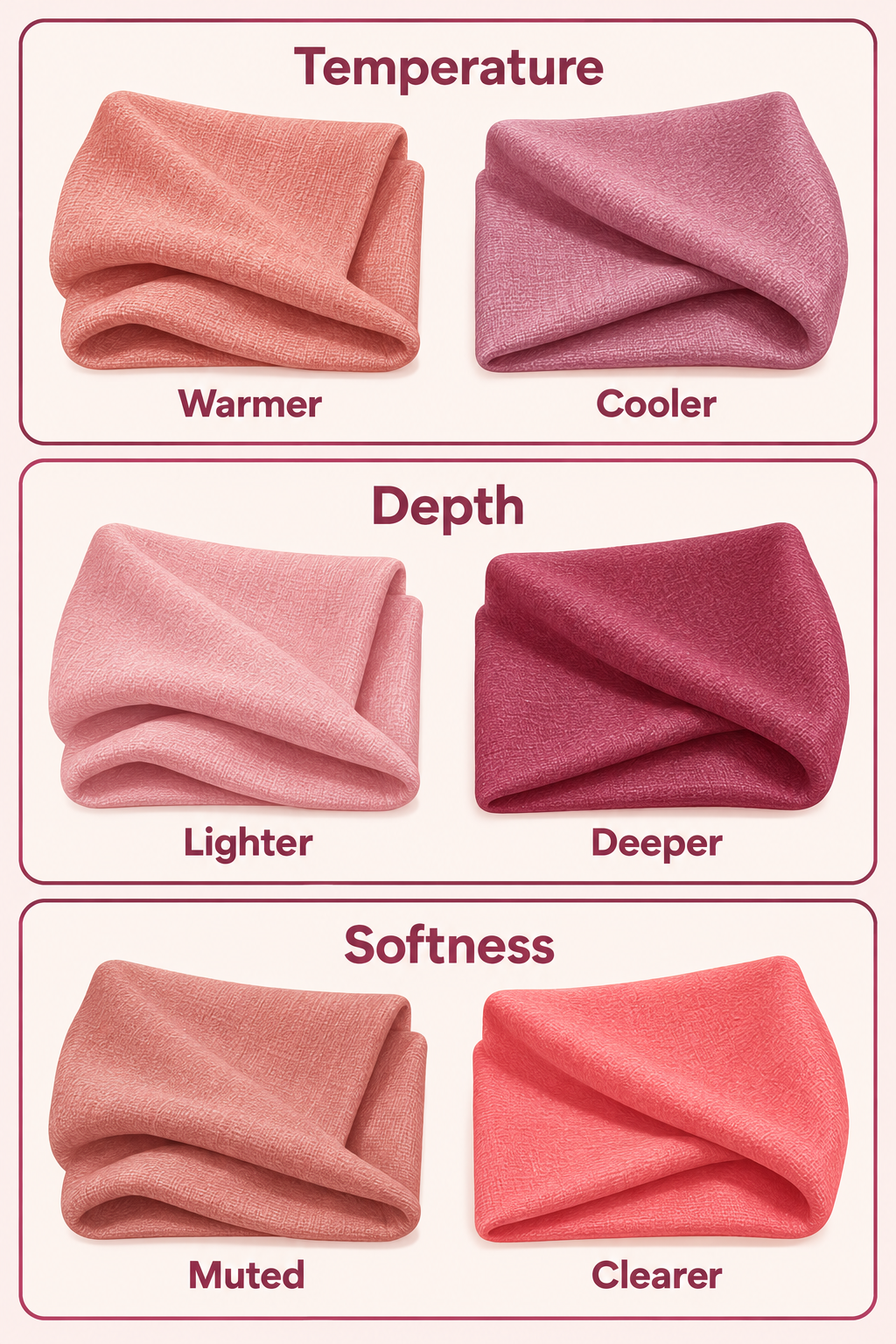
Explore the labeled color swatches
Temperature
- Warm rose
- Cool rose
Compare a warmer and cooler direction at a similar depth.
Depth
- Lighter berry
- Deeper berry
Compare a lighter and deeper version of a similar color family.
Softness
- Muted coral
- Clearer coral
Compare a muted and clearer version without also making a large depth change.
Use season names as shorthand
Seasonal analysis is a styling framework. House of Colour uses four main families; twelve-season systems subdivide them, while Colour Me Beautiful uses a different tonal approach. Names vary, so check the system behind a label. In common twelve-season vocabulary:
- Spring: warmer, clearer directions; Light, Warm or True, and Bright Spring.
- Summer: cooler, softer directions; Light, Cool or True, and Soft Summer.
- Autumn: warmer, earthier directions; Soft, Warm or True, and Deep Autumn.
- Winter: cooler, clearer directions; Bright, Cool or True, and Deep Winter.
Try a comparison you can repeat
Use fabrics and makeup you already own. A fabric comparison helps choose the next makeup experiment; it cannot select a foundation code or predict a lipstick formula.
- Face indirect daylight with a mirror. Keep your position and background consistent, and cover a brightly colored top with a neutral layer.
- Hold a warmer and cooler fabric below your face in turn. Choose similar depths and intensities. Note the effect you prefer, or record ‘no clear preference.’
- Repeat with a lighter/deeper pair, then a muted/clearer pair. Change one feature at a time; keep uncertain results open.
- Translate the clearest preference into one makeup comparison, such as two lip colors. Keep the rest of the face similar and judge each color on your lips in turn.
- Repeat the preferred combination on another day. Save the product, amount, finish, and observation before using a season name as shorthand.
Worked example: Soft Summer or Soft Autumn?
Suppose muted rose and muted peach both feel comfortable, while vivid pink feels stronger than you want. Softness is the clearer preference; temperature is still uncertain. Start with a small palette spanning neutral rose, muted peach, and brown.
Next compare rose and peach lip colors at similar depth and finish. If peach works only when applied sheer, record that. You have a useful application note without needing a definitive season. The lipstick comparison helps you test the next variable.
Keep the observation when the label stays unclear
If your phone photo reverses your mirror preference, repeat the mirror check before replacing products: lighting, camera processing, and screens affect color. A season also does not follow automatically from skin depth, ethnicity, or eye color.
Save three lines: ‘I preferred…’, ‘I am uncertain about…’, and ‘Next I will compare…’. Foundation remains a separate shade-matching task. Keep combinations you enjoy even when a label feels unhelpful.
Use Glowmi to choose a starting comparison
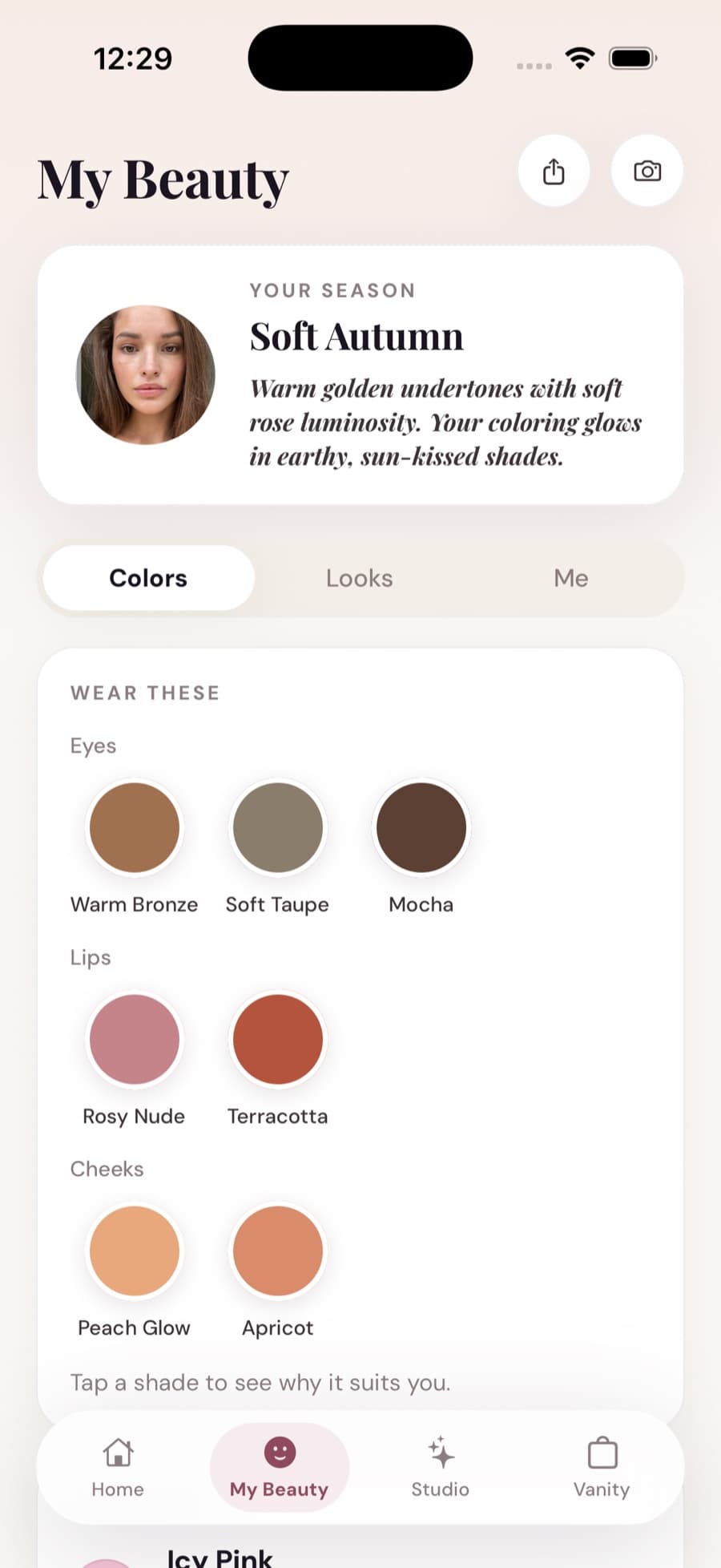
Glowmi suggests a twelve-season color type and eye, lip, and cheek shades from your selfie. Use them to choose a real-product comparison, then build a small palette or plan an eye combination. Photo analysis is a starting brief.
Glowmi is on iOS. Onboarding shows a season, first shade, and first look. Pro unlocks the full experience afterward, with no free trial and daily/monthly AI limits. See the App Store for current plans.
Sources and further reading
Brand references describe their own methods and products. Our worked examples are illustrative, not records of product tests.
- House of Colour: color analysis
Describes this provider’s four seasonal families, warm/cool comparisons, and in-person draping. Its claims describe its own service; they are not independent validation of a universal test.
- Color Allure: the twelve-season color system
A practitioner’s explanation of the twelve-family vocabulary, including Clear, Soft, Light, Deep, Warm, and Cool subdivisions. It describes a styling framework, not a diagnostic standard.
- Colour Me Beautiful: colour analysis
Describes a tonal approach rather than a seasonal one. Providers use different frameworks, so their labels are not interchangeable.
- Colour Me Beautiful: the colour collection
Uses light, deep, warm, cool, clear, and soft as color characteristics. Our comparison routine below is an editorial exercise, not this provider’s consultation protocol.
Keep reading
What Is Skin Undertone? A Practical Guide for Makeup
Understand undertone versus skin depth, compare real swatches, and turn mixed results into useful shade notes without relying on one shortcut.
What Makeup Colors Suit Me? Build Your Personal Palette
Find eye, lip, and cheek colors you enjoy wearing together. See a Glowmi color-season example, compare real products, and build a personal makeup palette.
How AI Skin Analysis Works for Makeup Guidance
Prepare a useful selfie for AI makeup analysis, understand its limits, and test a suggested shade or technique in real life before relying on it.